
4931 S. CR 250 W.
Vallonia, IN 47281
812-358-4110
on.IN.gov/driftwood-sfh
Get Directions
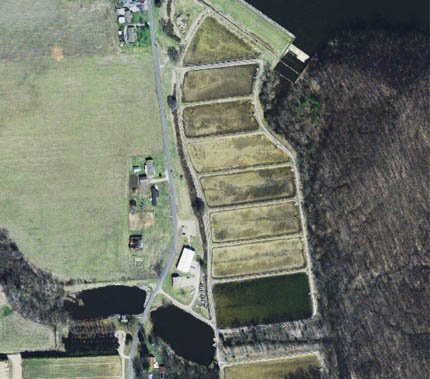
The Driftwood State Fish Hatchery, located in Vallonia, IN, in Jackson County, and constructed under the Works Projects Administration (WPA) in the late 1930's, this warm water facility consists of earthen rearing ponds and one brood-fish holding pond. The rearing ponds range from 0.6 to 2.0 acres in size and provide a total of 11.6 acres for raising fish. Maximum depth of each rearing pond is approximately 5 feet. Five, 1,000-gallon linear raceways, housed in the fish culture portion of the office/service building, provide facilities for feed training, and fish holding.
The primary fish culture responsibilities of the hatchery are the production of Largemouth bass and Channel Catfish fingerlings for stocking in Indiana’s many public waters. However, most all warm-water and cool-water species can be produced at this facility. Species raised in the past include bluegill, redear sunfish, black crappie, walleye, hybrid walleye, northern pike, and muskellunge.
Starve Hollow Lake is the sole water supply to the hatchery. Water is drawn from a depth of approximately 6.5 feet and gravity fed to the hatchery ponds. The water is passed through a 382-micron mechanical strainer to prevent contamination with lake fish, which would compete with or prey on, those being raised. Water for the inside raceways is pumped from the brood-fish holding pond and/or Starve Hollow Lake.
The hatchery is staffed by one Property Manager, one Assistant Property Manager, and the Statewide Hatchery Secretary. The District 7 Private Lands Wildlife Biologist is also headquartered at the hatchery.
The hatchery is funded entirely from the Fish & Wildlife Fund, which is comprised of monies generated from the sale of hunting, fishing, and trapping licenses. All monies spent for hatchery operation are eligible for 75% reimbursement from Federal Dingle-Johnson and Wallop-Breaux funds.
Fish Culture
- Largemouth Bass
Largemouth bass production begins in April. Near the end of April, as water temperature approaches 65ºF, the bass brood fish are removed from the holding pond at Cikana SFH, identified by sex, and transferred to the spawning pond(s) at Driftwood. The spawning pond(s) at Driftwood have premade nest mats made of a combination of Spawntex material and 5L river gravel. Approximately 50 pairs are stocked per acre.
The male will select a spawning site by fanning the gravel free of silt with his tail. He then guards the site until a female arrives to deposit her eggs. The eggs are pale yellow in color, about 1.5 millimeters in size (0.06 inches), and have a sticky covering which allows them to adhere to the spawning mat. Once spawning is completed, the female leaves and the male remains to care for the eggs.
At this point, hatchery staff check the nests daily for the presence of eggs. Nests that have eggs present are transferred inside the culture building and suspended vertically in the raceways. Hatching occurs 3 to 5 days after spawning. An additional 10 to 14 days are required for the fry to develop to the “swim-up” stage, at which time they will “school” in the raceways. The fry are then collected and are stocked in the production ponds at 50,000 fry per acre for Phase 1 (short) production.
Preparation of the production ponds begins when brood-fish are moved to the spawning pond. The ponds are filled, and organic fertilizers (alfalfa meal or soybean meal and /or cottonseed meal) and inorganic fertilizer (18-46-0) are applied. The fertilizer promotes phyto- plankton (minute plants) production, which in turn promotes zooplankton (tiny aquatic animals) production. The zooplankton provides forage for the bass fry during this early stage of life.
Organic and inorganic fertilizer is applied weekly to maintain maximum plankton density. The fry will remain in the nursery ponds for 25-30 days, at which time they will be approximately 2.0 inches in length.
At 2.0 inches in length, the bass require larger prey, such as aquatic insects or small fish. The bass are removed from the nursery ponds, graded to ensure size uniformity, and transferred to grow-out ponds for rearing to a fall stocking size of 4.0 inches. The number stocked is reduced to 11,000 per acre to ensure the ability of the pond to produce adequate forage is not exceeded.
Indiana state fish hatcheries do not sell fish.
- Redear Sunfish
Redear sunfish generally begin spawning in late May and continue into July. Like its cousin, the largemouth bass, redear are nest builders and the male assumes the chores of nest construction and nest protection. Unlike bass, redear nest in colonies, with several nests in close proximity. Most avid pan fish anglers are quite familiar with the “moon scape” of a redear nesting area.
- Channel Catfish
Channel catfish yearlings, four to five inches in length, are picked up at East Fork SFH in late June and stocked in a pond previously use for bass “short” production. The fingerlings are fed a 36% protein floating commercial diet twice daily until mid October at which time they will be 9 to 12 inches in length and ready for stocking.
- Fathead Minnows
Fathead minnows begin spawning in May and continue through August. The eggs are deposited on the underside of objects in the pond and are attended by the male. Fathead minnows are fast growers, with some individuals spawning the same season they were hatched.
Fathead minnows forage on plankton, and fertilization techniques similar to that used for game fish production are used to increase plankton numbers for the minnows.
Fathead minnows are raised to provide forage for the largemouth bass brood fish housed at the facility. Approximately 2,000 pounds of forage fish are required annually to maintain Indiana’s largemouth bass captive brood-stock program.
- Operations
Driftwood is an extensive culture facility. Most fish species are raised on the food items that occur naturally in ponds, such as zooplankton (i.e., minute animals), aquatic insects, frogs, snails, etc. The number of fish that can be raised is limited by the amount of forage the pond can produce, which is known as its carrying capacity. Fish production can be increased above the natural carrying capacity of a pond by using formulated feeds. Some species take readily to artificial diets.
To be as efficient as possible, ponds are multi-cropped. For instance, fathead minnows are usually raised in ponds previously used for bass short fingerling rearing, channel catfish are raised in ponds previously used for bass spawning, and so on.
Maintaining adequate water quality is an important task in the operation of the hatchery. Oxygen must be maintained above 5 parts per million or growth and survival will be reduced. Other gases (e.g., carbon dioxide, nitrogen, etc.) must remain below critical lethal concentration. Oxygen concentration is typically monitored at first light, when the level is theoretically at its lowest, and is monitored more closely during the summer months in spring and fall, usually daily. This is because warm water holds less oxygen than cold water. In addition, higher temperatures result in increased metabolic and respiration rate in fish and increased decomposition of organic matter, which causes increased oxygen use.
Mechanical aeration/circulation is used to improve the water quality of the pond. A centrally located 150 CFM blower system supplies aeration to the nine rearing ponds. Atmospheric air is injected near the bottom in the deep end. As the air rises, the upper water is pushed away, and the bottom water moves in to fill the void (note the boil). This action causes the pond to continuously “turn over”, which in turn mixes oxygen throughout the water column. It also keeps nutrients suspended in the water and available for plankton use.
During the growing season, aquatic vegetation is monitored and controlled as needed. “Summer kills” occur when oxygen depletion results from a die-off of a large algal bloom or extensive weed growth. Pond harvest is also affected as the fingerlings become trapped under the vegetation. Also, excessive algae plugs screens, slowing harvest and subjecting the fingerlings to longer periods of stress.
Fish production accounts for only part of the day-to-day operation of an extensive culture operation. Mowing and trimming of grounds to maintain a pleasant appearance; mowing levees to aid in the detection of muskrat dens and limit fish predators and disease vectors; maintaining buildings and structures; maintenance, repair and fabrication of equipment; and administrative duties are all equally important to the operation of the hatchery.
The months of October and November are generally when the fall fingerling ponds are harvested in preparation for stocking public waters. The fingerlings are moved to the culture room, graded, counted, weighed, and measured, and then loaded at the prescribed pounds of fish per gallon of water into insulated transport tanks for the trip to their new home. While in transit, water conditioners, bottled oxygen, and agitation are applied to the transport water to minimize stress and ensure a healthy product. At the lake, the fingerlings are acclimated to the temperature and chemistry of the receiving water before being unloaded.
VOLUNTEER OPPORTUNITIES
Need a reason to get outside and move? You can volunteer alone or in small groups at this property. Some activities include trash pick-up, basic gardening, painting, and more. Call the property office for details.