
Quick Facts:
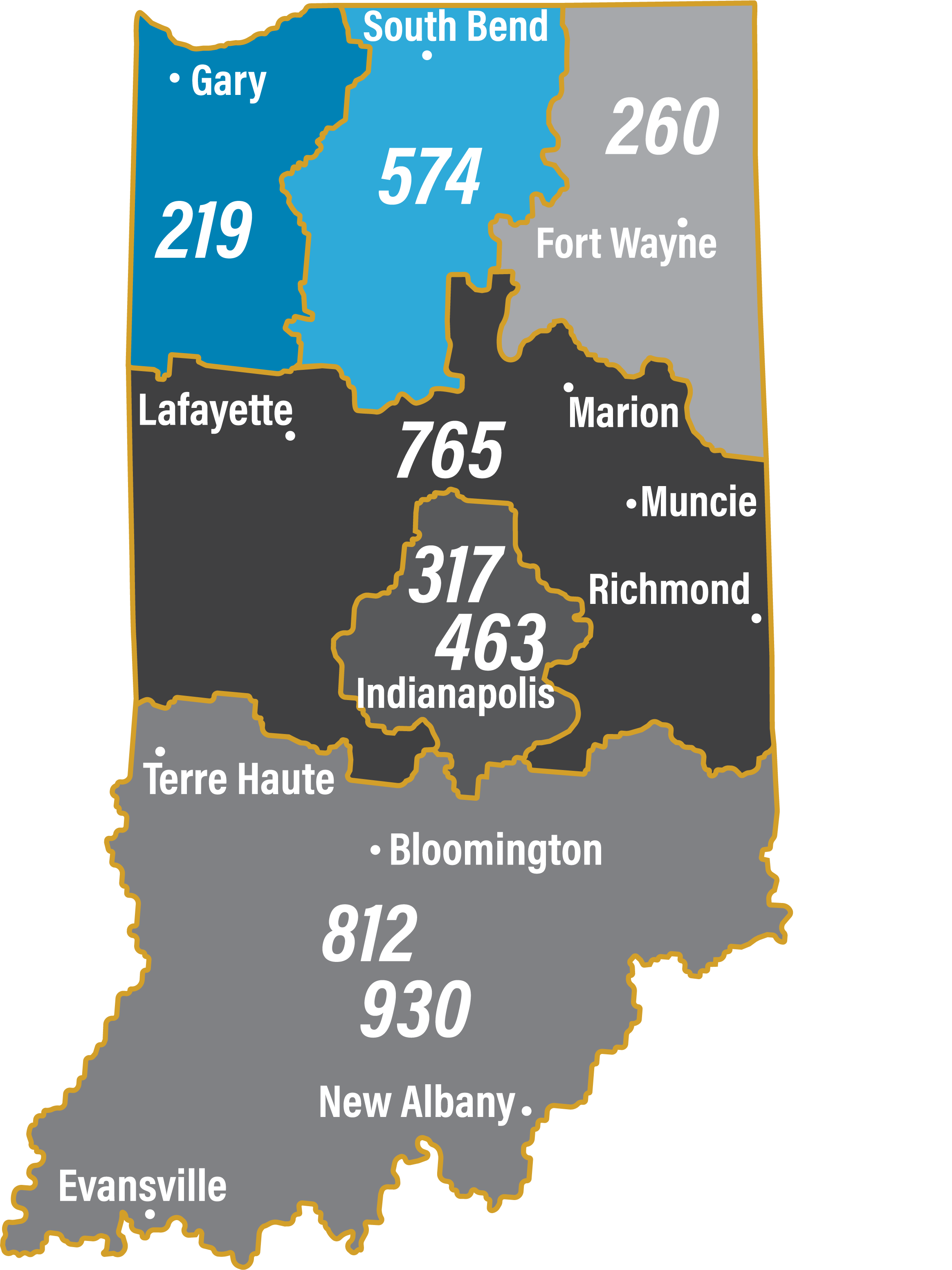
- Indiana has eight telephone area codes, including two that were added within the last decade:
- The 219 and 574 area codes implemented 10-digit dialing in 2021. The changes were needed to accommodate the 988 National Suicide Prevention Lifeline.
- The 765 area code is projected to need relief by 2029.
- History
Indiana had three telephone area codes from the mid-1950s until the mid-1990s: 219, 317, & 812.
Today, the state has eight area codes.
Indiana’s telecommunications trends in the 1990s mirrored those throughout North America. With wireless phones, pagers, fax machines, home computers with Internet connections, and other new technologies being launched, consumers started to need new phone numbers at an unprecedented rate. Efforts to conserve existing number supplies and prolong the life spans of area codes have been successful. However, the only way to provide new numbers in the long run has been to introduce new area codes.
The number of area codes throughout the United States, Canada and the Caribbean has more than doubled since 1995, with Indiana, 39 other states, and all ten Canadian provinces adding new area codes. While the need for new numbers continues, the pace has slowed dramatically over the last decade because of number conservation efforts that make more efficient use of existing number supplies and have delayed the need to implement many new area codes.
- Short-Term Solutions
The most significant number conservation effort in Indiana is "1,000 block number pooling," which the state started using in 2001. Traditionally, telecommunications providers were allocated blocks of 10,000 numbers, which often left numbers unused. Now, numbers can be allocated in blocks of only 1,000. The use of 1,000 block number pooling has significantly delayed the need for new area codes in most of Indiana.
- Long-Term Solutions
After efficiency efforts are exhausted, a new area code must be implemented. Two primary methods have been used.
The geographic split was the primary method of implementing new area codes throughout the United States and Canada before 2005. Under this method, an existing area code zone was split into at least two parts. One part typically kept the original area code while the other part(s) would be assigned a new area code. A geographic split did not change the boundaries of a consumer’s free local calling area. Most local calls are still placed using seven-digit dialing.
The overlay has been the primary method of implementing new area codes since 2005 and the only method used in the United States since 2008. With this method, a new area code "overlays" the entire geographic area covered by the existing area code. Existing phones and devices retain current area codes and phone numbers, but new phones and telecommunications devices may be assigned numbers using the new area code. An overlay does not change the boundaries of a consumer’s free local calling area, but all calls - including free local calls - usually require 10-digit dialing.
- Recent Changes & Status
317 & 463
The 317 area code for Indianapolis and most of its suburbs was projected to run out of numbers in the fourth quarter of 2016. Accordingly, the new 463 area code was added in November 2016.Number conservation efforts extended the 317 area code’s lifespan by more than 14 years over earlier projections.
With the new area code is in place, the 317/463 region is not expected to need additional area code changes until 2047.
812 & 930
The new 930 area code was added throughout southern and south-central Indiana in 2015. It overlays the 812 area code.Forecasts in the early 2000s projected that 812 would run out of numbers in 2004, but 1,000 block number pooling and other conservation efforts extended 812’s lifespan by a decade.
With 930 implemented, southern Indiana is not expected to need any additional area code changes until 2058.
765
The 765 area code, serving most of central Indiana outside the Indianapolis metropolitan area, was split from 317 in 1996.Number conservation efforts have pushed 765’s projected exhaust date to the third quarter of 2029.
Northern Indiana
The 260 and 574 area codes were split from the 219 area in 2001. The 219 and 574 area codes were required to convert to 10-digit dialing due to implementation of the national 988 National Suicide Prevention Lifeline.219 and 574 were among about 80 area codes throughout the US making this transition in 2021.
The National Suicide Prevention Lifeline is reachable nationwide by calling the three-digit 9-8-8 code. The lifeline can be reached before and after that date at 1-800-273-TALK (8255).
The transition to 10-digit dialing does not affect the 260 and 765 area codes.
Projected exhaust dates for northern Indiana's area codes are:
- 219: 2041
- 574: 2078
- 260: 2053
Note
* Projections are according to North American Numbering Plan Administration (NANPA) data. NANPA is the neutral, third party administrator that oversees area code assignments. For additional information on area code relief, as well as state maps of area codes in North America, visit NANPA’s Website at nationalnanpa.com.
3-7-2025