
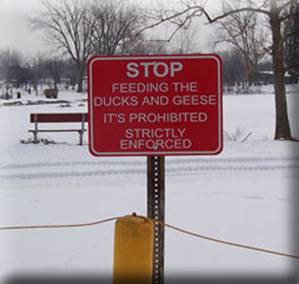
Urban areas are attractive places for Canada geese because they prefer nicely groomed lawns adjacent to water. This preference, along with reduced predator rates, limited hunting, and feeding by humans, results in waterfowl concerns in highly populated areas. Modification techniques can be implemented to mitigate large congregations of Canada geese. It is also suggested that urban planners and building contractors design projects with these habitat modifications in mind. It is generally easier and more economical to implement goose mitigation techniques prior to building a site than changing an existing site.
Do Not Feed Wildlife
Feeding waterfowl is a popular practice for many people, but it is also a major reason why Canada geese are attracted to certain areas and remain there for long periods of time. Feeding Canada geese concentrates large numbers of them in areas that under normal conditions would only support a few. This can happen through intentional feeding by humans, such as bread and grapes, but also accidental feeding, including overspill from birdfeeders and pet food.
Artificial feeding can disrupt normal migration patterns and hold Canada geese in areas longer than normal. With an abundant source of artificial food available, Canada geese can devote more time to locating nesting sites and mating. Feeding waterfowl also increases the susceptibility to avian diseases, which have the potential to kill large numbers of Canada geese and other waterfowl. Feeding waterfowl (or any wildlife in an area) usually makes other forms of management ineffective. Finally, human food sources rarely provide proper nutrition for waterfowl and frequently do more harm than good.
Individuals and communities should consider adopting a “No Feeding Wildlife” policy. These policies are more successful if they are strictly enforced and if signage is posted showing the negative health consequences for feeding wildlife. Reducing food handouts by well-intentioned people should help make the area less attractive to waterfowl and other wildlife.
Barriers
- Vegetative Buffer Strips
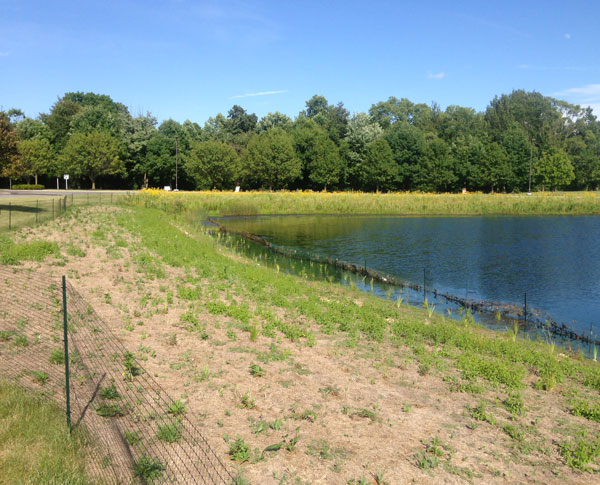
Vegetative buffer strips are wide areas around the perimeter of a body of water that are made up of growing plants. These strips act as a physical barrier to deter geese from using shorelines next to bodies of water. Canada geese like gently rolling slopes with short vegetation at the water’s edge. It provides a clear line of site to avoid predators and easy access to water. Tall, thick vegetative buffer strips are typically comprised of native warm season grasses, wildflowers (forbs), trees, and/or shrubs. If constructed properly with native plants, these buffers can reduce conflicts with geese while also creating habitat for pollinators, reducing maintenance of lawn care, and helping with shoreline stabilization.
Native warm season grasses and forbs remain tall and erect throughout the winter, making them an excellent choice for establishing buffer strips. For buffer strips to be effective, they must retain their mature height throughout the entire year. Therefore, any mowing of buffer strips will reduce their effectiveness and may render them useless as a goose deterrent.
Trees and shrubs may also be used for buffer strips. It is not recommended to establish trees or shrubs on dams or levees. A buffer strip used in conjunction with a suspended cable grid, described below, is particularly effective in deterring waterfowl from using a body of water. Buffer strips should be at least 30 feet wide and 3 feet tall to be effective. Several different seeding mixtures can be used for buffer strips. A District Wildlife Biologist can also be contacted for further recommendations,


- Rock Barriers
Rock barriers consisting of boulders at least 2 feet in diameter can be placed along the shoreline. Canada geese normally like to walk out of the water on bare, flat, or gently sloping banks. The effectiveness of a rock barrier can be enhanced when used in combination with vegetative barriers. Rip rap and smaller rocks around a pond will not deter Canada geese. Rules and regulations need to be examined prior to placing rock barriers on any body of water. Feeding Canada geese will make rock barriers ineffective.
- Fence Barriers
While fencing will not deter flying Canada geese, fence barriers will physically prevent Canada geese from walking out of the water into feeding areas like turf grass during their flightless time when they molt their flight feathers (typically mid-June through mid-July). Fencing can consist of woven wire, wooden or plastic snow fencing, chicken wire, silt fencing, netting, mylar tape, or several strands of heavy fishing line or wire. If using line or wire, it should be strung at intervals of 4, 8, 12, 18, and 24 inches above the ground. Make sure that the fence is long enough so the geese will not walk around the ends and that no opening is larger than three inches.
Fence barriers are most effective if they are placed prior to Canada geese scouting for nesting locations, which occurs as early as February. When scouting, Canada geese need to find areas where they can walk their goslings to the water when they hatch and when adults are molting. If a barrier is in place prior to nesting, it is more likely a mating pair will search elsewhere for a nesting location.
- Suspended Grid Systems
Creating a suspended grid system over water is a quick and cost-effective solution to deter waterfowl from inhabiting small bodies of water. Suspended grids create a barrier that physically prevents waterfowl from accessing water, making an area less attractive to Canada geese. Supplies for creating a grid include brightly colored twine or rope, 10- to 28-gauge wire, or mylar tape, along with stakes or poles strong enough to support the weight and tension of grid. High visibility is key.
Place stakes or poles in 5-foot increments along one side of the body of water and then repeat that process on the opposite side. Connect the corresponding stakes or poles on each side of the body of water with the twine, wire, or mylar tape. Once this is completed for the entire length of the body of water, complete this same process in a perpendicular fashion along the remaining two sides (Figure 1). As the lines are stretched across the body of water body, they should reach a height of 12 to 30 feet off the water’s surface. Make sure to use bright colored materials so that Canada geese can see the grid.
Using environmentally friendly and weather resistant materials will provide long term benefits without compromising the environmental integrity of the body of water.
Original Water Body

Step 1:
Stretch twine, wire, or mylar tape across the water body (5’ increments)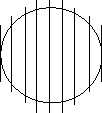
Step 2:
Stretch twine, wire, or mylar tape in
perpendicular fashion (5’ increments)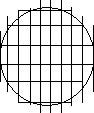
- Minimize Islands and Peninsulas
Islands and peninsulas are ideal nesting and resting sites for Canada geese. These areas are surrounded by water and offer protection and security from predators. When creating new ponds, lakes, or retention basins, consider reducing islands and peninsulas. Elimination of existing islands and peninsulas after construction is expensive and difficult.
- Minimize Aerators and Fountains
Minimize open water during winter. Open water attracts local and migrant Canada geese. They are attracted to the spray associated with fountains and aerator systems, which also keep water from freezing. Consider shutting them off in winter.
- Other Habitat/Landscape Modifications
Canada goose nests are often localized near landscaping features, adjacent to doorways or windows, and along paths. In such localized instances, quick fix solutions and temporary barriers can be employed. Some solutions include:
- Reducing mulch in landscaping and replacing with lava rock
- Using snow fencing or chicken wire to block waterfowl from areas
- Using electric fencing to deter waterfowl from entering open areas
- Avoiding landscaping structures that resemble “nesting structures”
- Applying approved chemical repellents to lawns and grass areas, following label instructions
- Employing decoys of “would-be” predators to deter waterfowl (remember to move them regularly, and unpredictably).